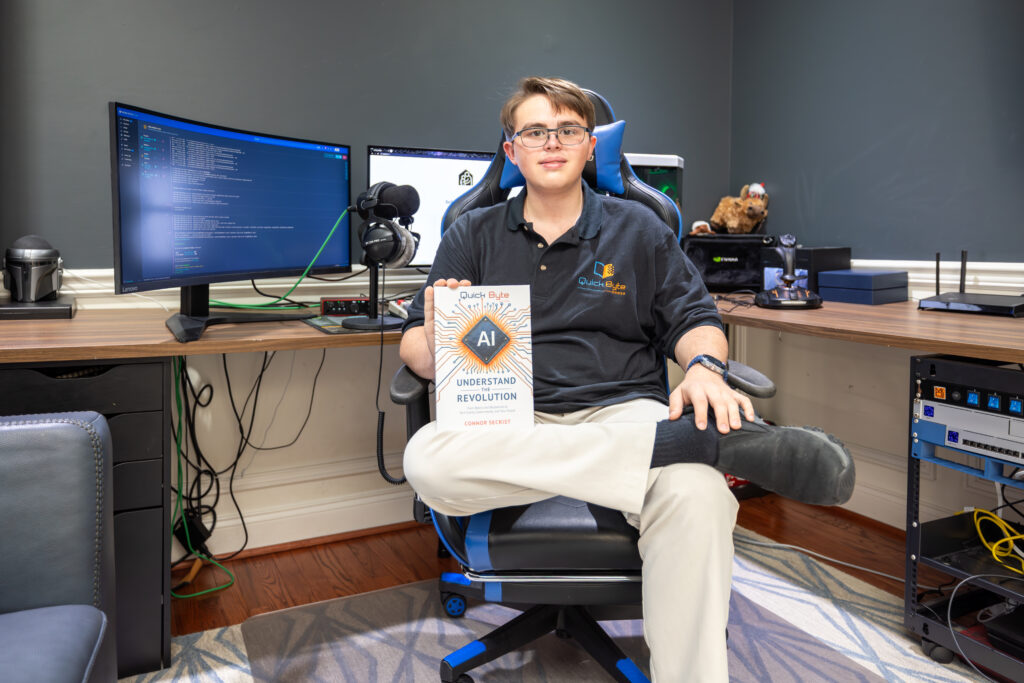
I didn’t set out to write a book. I set out to explain something.
You see, I’m the “tech guy” in my family—the one everyone calls when the Wi-Fi goes down or when some new app suddenly changes everything. But as AI started dominating headlines, I realized something important: most people didn’t actually understand what was happening.
They knew the buzzwords—ChatGPT, deepfakes, neural networks—but not what those things meant. Not how deeply they were already shaping their lives. And when I tried to explain, I saw the same blank look in my family’s eyes that I’ve seen on millions of faces scrolling past the biggest technological shift since the internet.
Then one day, my grandmother—who still handwrites her grocery lists—looked up from her coffee and said, “Connor, why don’t you just write it all down?”
So I did.
That simple idea turned into six months of intense research, sleepless nights, and a word document that eventually became *AI: Understand the Revolution*. I poured everything into it—every discovery, every late-night “aha” moment, every terrifying and exhilarating insight about where we’re headed.
The Moment It Hit Me
At some point during the writing, I realized I wasn’t just studying AI—I was partnering with it.
As someone with dyslexia, writing has never been easy. But AI changed that. It didn’t fix my dyslexia; it amplified my ability to communicate despite it. Suddenly, I could take complex thoughts from my head and shape them into clear, engaging ideas that made sense to others. That’s when it clicked: this isn’t about replacement—it’s about *amplification*.
That realization became the heart of the book: AI isn’t here to replace you. It’s here to partner with you. The people who thrive in the future won’t be the ones who fear it, but the ones who learn how to collaborate with it.
The Terrifying Beauty of What’s Coming
The deeper I researched, the more amazed—and honestly, scared—I became.
What stunned me most wasn’t how smart AI had become—it was how centralized it is. The future of intelligence is being built by a handful of companies that already control much of our data, our digital lives, even the flow of information itself. That’s a staggering amount of power in very few hands.
And beyond that? Artificial Super Intelligence. The concept sounds like science fiction, but it’s closer than most realize. The idea that a machine could one day answer humanity’s biggest questions in minutes is breathtaking—and terrifying. If it’s not aligned with human values, those answers could destroy everything we’re trying to save.
That’s why alignment matters. That’s why understanding matters.
The Hardest Chapter to Write
The chapter on how governments are responding to AI nearly broke me.
Unlike the tech world, which moves at light speed, governments move like they’re walking through molasses.
Writing that chapter meant reading hundreds of policy papers, parsing contradictory strategies, and realizing just how fragmented our global response really is. But it also opened my eyes to how critical this moment is.
We’re not just living through a technological revolution—we’re living through a governance revolution.
Why I Wrote It—for You
At its core, AI: Understand the Revolution is my attempt to bridge the gap between the tech world and everyone else.
It’s for my grandmother. For my mom. For the student trying to figure out what to study. For the small business owner wondering how to stay relevant. For the everyday person who just wants to understand what’s actually going on.
AI isn’t coming—it’s already here. It’s in your phone, your photos, your playlists, your routes to work. You don’t have to be an engineer to understand it; you just have to be curious enough to look closer.
My hope is that this book gives people the language—and the courage—to do exactly that.
Because the future won’t belong to the people who resist AI.
It’ll belong to those who learn to partner with it.
“The revolution isn’t coming. It already happened.” Now it’s time we start understanding it.
Available on Amazon, Audible and Apple Books.